








초록접수 현황
| 19F-108 | 구연 미채택시 포럼 발표 |
Cortical and Subcortical Changes in Resting-state Functional Connectivity during an Episode of Postoperative Delirium : Functional Magnetic Resonance Imaging Study.
Tae-Hoon Kim¹, Jooyoung Oh², Jae-Jin Kim², Suk-Won Song¹, Woon Heo³, Kyung-Jong Yoo⁴, Byung Chul Chang⁵, Bum-Koo Cho⁶
¹Department of Thoracic and Cardiovascular Surgery, Gangnam Severance Hospital, Yonsei University College of Medicine, Seoul, Republic of Korea, ²Department of Psychiatry, Gangnam Severance Hospital, Yonsei University College of Medicine, Seoul, Republic of Korea, ³Department of Thoracic and Cardiovascular Surgery, Inje University Haeundae Paik Hospital, Inje University College of Medicine, Busan Republic of Korea, ⁴Department of Thoracic and Cardiovascular Surgery, Severance Cardiovascular Hospital, Yonsei University College of Medicine, Seoul, Republic of Korea, ⁵Department of Thoracic and Cardiovascular Surgery, CHA Bundang Medical Center, CHA University College of Medicine, Gyeonggi-do, Republic of Korea, ⁶The Korea Heart Foundation, Seoul, Republic of Korea
Purpose : This study aimed to elucidate the underlying neural mechanisms of delirium and impact of circulatory arrest on delirium.
Methods : Forty-seven patients who underwent aortic surgery were postoperatively scanned using resting-state functional magnetic resonance imaging (fMRI). Thirty patients developed postoperative delirium. Of those, fMRI during delirium state and on recovery state was conducted in 24 and 21 patients, respectively. Seventeen patients without delirium completed postoperative fMRI 5 or 6 days after surgery. Thirty-one patients underwent arch repair with moderate hypothermic circulatory arrest. We assessed group differences in voxel-based connectivity, in which the seeds were the posterior cingulate cortex (PCC), medial prefrontal cortex (mPFC).
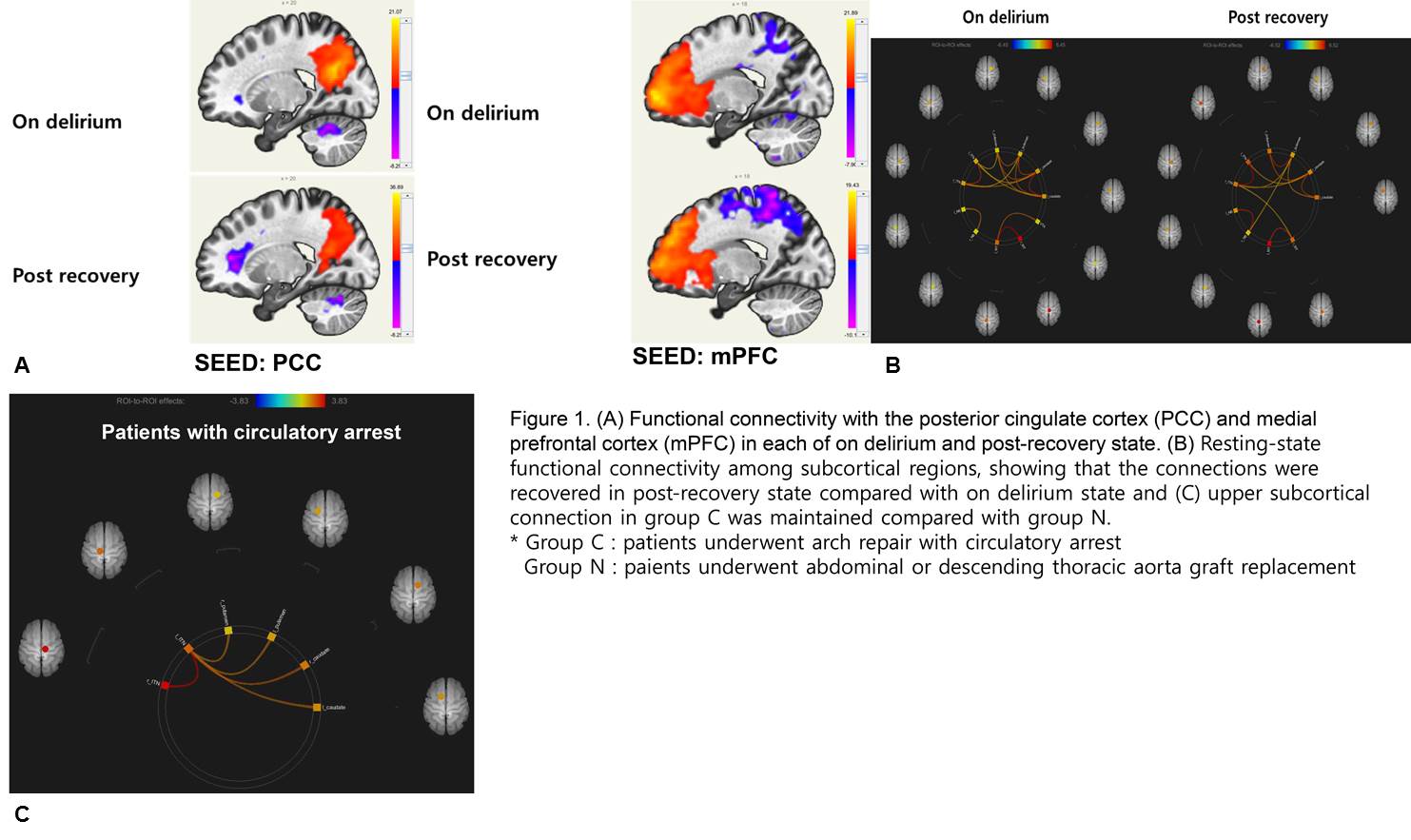
Results : A common result between PCC and mPFC-based connectivity was found in the dorsolateral prefrontal cortex, which showed increased connectivity in delirium state compared to the recovery state (Figure 1A). The connections between mesencephalic tegmentum and intralaminar thalamic nucleus were not noticeable during delirium when connectivity among the subcortical regions was investigated (Figure 1B). In patients who underwent arch repair, functional connections between upper subcortical regions were significantly preserved compared with the others (Figure 1C).
Conclusion : Our findings suggest that cortical dysfunction during delirium is characterized by excessive internal connections in the posterior default mode network and a complex imbalance of internal connectivity in the anterior default mode network. Moderate hypothermia with cerebral perfusion may have a role to reset the subcortical connectivity. Cortical-subcortical connectivity and correlation between stroke and resting-state functional connectivity need to be investigated to elucidate the impact of circulatory arrest on delirium.
Methods : Forty-seven patients who underwent aortic surgery were postoperatively scanned using resting-state functional magnetic resonance imaging (fMRI). Thirty patients developed postoperative delirium. Of those, fMRI during delirium state and on recovery state was conducted in 24 and 21 patients, respectively. Seventeen patients without delirium completed postoperative fMRI 5 or 6 days after surgery. Thirty-one patients underwent arch repair with moderate hypothermic circulatory arrest. We assessed group differences in voxel-based connectivity, in which the seeds were the posterior cingulate cortex (PCC), medial prefrontal cortex (mPFC).
Results : A common result between PCC and mPFC-based connectivity was found in the dorsolateral prefrontal cortex, which showed increased connectivity in delirium state compared to the recovery state (Figure 1A). The connections between mesencephalic tegmentum and intralaminar thalamic nucleus were not noticeable during delirium when connectivity among the subcortical regions was investigated (Figure 1B). In patients who underwent arch repair, functional connections between upper subcortical regions were significantly preserved compared with the others (Figure 1C).
Conclusion : Our findings suggest that cortical dysfunction during delirium is characterized by excessive internal connections in the posterior default mode network and a complex imbalance of internal connectivity in the anterior default mode network. Moderate hypothermia with cerebral perfusion may have a role to reset the subcortical connectivity. Cortical-subcortical connectivity and correlation between stroke and resting-state functional connectivity need to be investigated to elucidate the impact of circulatory arrest on delirium.
책임저자: Suk-Won Song
Department of Psychiatry, Gangnam Severance Hospital, Yonsei University College of Medicine, Seoul, Republic of Korea
발표자: Tae-Hoon Kim, E-mail : airtech2@naver.com